- 12741 Research Blvd. Suite 500 Austin, TX
- sales@rastracmarinevision.com
- (877) 680-1188
The marine industry is experiencing a fundamental shift in how boating experiences are accessed and enjoyed. Platforms like Boatsetter and GetMyBoat have opened the door for private owners to monetize their watercraft between personal outings, while fractional ownership syndicates allow multiple families to share a single yacht without the burden of sole ownership. Yacht clubs are expanding fleets to meet surging demand from members who want access without the maintenance headaches.
But shared access creates shared risk. When you hand the keys to a $100,000 speedboat to a renter you’ve never met, how do you know they won’t push it into restricted shallows or run the engines past redline? When five co-owners split a center console, how do you ensure fair, transparent billing for engine hours and fuel consumption? The answer lies in discrete, automated marine GPS tracking. Rastrac Marine Vision acts as your invisible anchor protecting luxury assets, validating billing, and lowering operating costs across the shared boating economy.
Renting out a private watercraft on a P2P platform can feel like a gamble. Once a boat departs the dock, traditional owners are completely blind to its treatment, location, and operating conditions. You have no visibility into whether the renter is respecting your boundaries or pushing your sailboat beyond its design limits.
Marine Vision eliminates this anxiety through silent, real-time monitoring that operates invisibly in the background:
Discrete Hardware Installation
Ultra-compact GPS devices like the ST4215 mount out of sight beneath consoles or inside hatches. Renters experience your yacht or pontoon boat without feeling micromanaged, while you maintain complete situational awareness from your smartphone. The hardware integrates seamlessly without disrupting premium aesthetics or alerting operators to its presence.
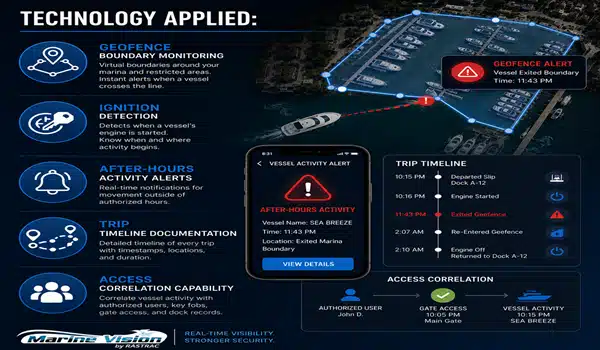
Geofenced Boundaries Prevent Expensive Groundings
Owners establish virtual perimeters around shallow shoals, sandbars, rocky outcrops, and open-ocean limits. If a renter crosses these invisible lines, you receive an instant text or email alert allowing you to intervene via phone before a costly grounding damages your hull or propeller. One documented case study showed rental operations reducing propeller damage by 75% in the first season after installing geofencing enforcement.
Boat theft costs the marine industry over $300 million annually, and only 10-30% of stolen watercraft without GPS tracking are ever recovered. GPS-equipped boats, by contrast, have recovery rates exceeding 80%. For P2P operators whose boats sit at public marinas between rentals, this protection is non-negotiable.
Aggressive Handling Detection
Integrated accelerometers detect rough treatment including hard impacts against docks, excessive throttle acceleration, and aggressive cornering. These events trigger alerts with timestamped evidence giving you objective data to claim security deposits when renters return your fishing boat with unexplained hull damage or bent railings. Rental operations using geofencing enforcement report damage claim reductions of 40-60%, directly protecting your bottom line.
Real-World Scenario: The Weekend Warrior Who Went Rogue
A Florida yacht owner listed his 32-foot center console on a rental platform for weekend charters. The renter’s profile looked solid, good reviews, stated boating experience, security deposit paid. But thirty minutes after departure, the owner’s phone buzzed with a geofence alert: his boat had crossed into a marked no-wake zone near a manatee sanctuary.
A quick call revealed the renter “didn’t see the signs” and was speeding through protected waters. The owner directed him back to approved areas, avoiding a potential $500 fine and protecting the watercraft from wildlife collision risk. Without real-time GPS tracking, he would have discovered the violation only after returning the boat – when it was too late to intervene.
Yacht clubs and fractional ownership models depend on trust and transparent accounting. But tracking shared usage based on manual logbooks or honor systems inevitably breeds disputes. One co-owner claims they “barely used” the deck boat last month, while engine-hour data reveals twelve heavy hours across a holiday weekend.
Marine Vision replaces guesswork with hard telematics data that eliminates billing friction:
Precise Engine-Hour Logging
The system directly monitors ignition status and logs exact runtime down to the second. No rounding, no estimates, no debate. When a co-owner starts the engines on a shared sailboat at 9:47 AM and shuts them down at 3:22 PM, those exact hours populate the cloud-synced database automatically.
Cloud-Synced Member Profiles
By cross-referencing your club’s booking calendar with Marine Vision’s trip history reports, management calculates exact usage metrics for each member without manual data entry. The system knows who reserved the pontoon boat for Friday afternoon, how long the engines ran, and how many nautical miles were logged. This automation ensures completely transparent, dispute-free billing for:
Scenario: The Co-Owner Who Always “Forgets” to Log Hours
A six-member yacht syndicate in San Diego shared a 40-foot catamaran under a fractional ownership agreement. Each member paid monthly dues proportional to their documented usage, relying on a paper logbook at the helm station. But one member consistently “forgot” to record his outings claiming he’d used the yacht for “just a quick sail” when confronted about blank log entries.
After installing Marine Vision, the truth became undeniable. Engine-hour reports revealed this member had logged 47 hours over three months while claiming only 18 hours in the paper book. The syndicate used the data to recalculate his fair share of maintenance costs, recovering $1,800 in unpaid contributions. More importantly, the objective data removed all personal conflict – the numbers spoke for themselves.
For commercial yacht clubs and active P2P operators, insurance premiums represent one of the highest recurring overhead costs. Underwriters view shared-economy watercraft as high-risk assets because they’re frequently operated by less-experienced captains in unfamiliar waters.
Deploying robust GPS tracking completely changes the underwriting conversation:
Proving Risk Mitigation to Brokers
When you present historical Marine Vision safety reports to your insurance broker, you demonstrate that your fleet is actively monitored against theft, restricted-zone entry, and reckless operation. This shifts the risk profile from “unmonitored shared boats” to “professionally managed fleet with geofencing and real-time oversight.”
Insurance carriers recognize this difference. Many marine insurers offer premium discounts of 5-15% for fleets equipped with active GPS tracking and geofencing capabilities. Over a multi-boat club with eight watercraft, these savings directly offset hardware installation costs within the first year and continue delivering ROI every renewal period afterward.
Reducing Manual Oversight by 80%
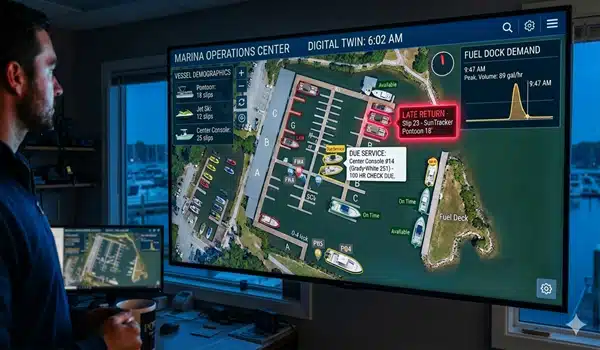
Without telematics, marina managers spend hours each week manually checking boats, reviewing paper logs, and fielding member questions about availability and usage history. Marine Vision reduces manual fleet monitoring by approximately 80%, freeing your team to focus on member experience, facility maintenance, and revenue growth instead of asset babysitting.
Rastrac Marine Vision isn’t a generic car tracker retrofitted for boats – it’s purpose-built for the unique demands of marine environments and shared-economy models:
Hardware options include the ST4215 for coastal operations within cellular range, and the ST9100 hybrid satellite/LTE tracker for offshore excursions beyond cell towers. Installation is straightforward with no complex wiring required – battery-powered and solar-powered options eliminate the need for hardwired connections on boats without accessible power systems.
How do I install GPS tracking without alerting renters or co-owners?
The ST4215 and RASTRAC devices are compact enough to mount out of sight beneath helm stations, inside storage compartments, or under gunwales. Battery-powered and solar-powered options require no wiring, allowing completely discrete installations. For permanently docked club boats, hardwired installations provide continuous power with minimal installation time.
Can GPS tracking really reduce my insurance premiums?
Yes. Many marine insurance carriers offer discounts of 5-15% for watercraft equipped with active GPS tracking and geofencing. Contact your broker with documentation showing your Rastrac Marine Vision deployment – the risk-mitigation value often translates directly to premium reductions that recoup hardware costs within 12-24 months.
What happens if a renter disables the GPS device?
Marine Vision devices include tamper alerts that notify you immediately if power is disconnected or the unit stops reporting. You’ll receive a text or email within minutes, allowing you to contact the renter and investigate the cause. Battery-powered units continue operating even if a renter disconnects external power.
How accurate is GPS tracking for billing disputes in fractional ownership?
Marine applications achieve accuracy within 10 feet for position tracking. Engine-hour logging is precise to the second, eliminating rounding errors that accumulate over time. Cloud-synced reports provide timestamped evidence that resolves billing disputes with objective data – not he-said-she-said arguments.
Does GPS tracking work offshore beyond cellular coverage?
Yes. The RASTRAC ST9100 hybrid tracker automatically switches between LTE cellular and satellite communication based on availability. When your yacht ventures beyond coastal cell towers, the device seamlessly transitions to satellite mode, ensuring continuous tracking regardless of distance from shore.
he shared marine economy unlocks incredible revenue opportunities for private owners and yacht club operators alike. But shared access demands professional oversight – the kind that operates invisibly 24/7 without requiring manual intervention. Whether you’re monetizing your sailboat on a P2P platform to offset slip fees or scaling a multi-yacht club to meet surging membership demand, Rastrac Marine Vision provides the digital anchor protecting your peace of mind and your bottom line.
Stop gambling with high-value assets. Start tracking with purpose-built marine telematics that reduces damage claims by 40-60%, cuts insurance premiums by 5-15%, and eliminates billing disputes with objective, cloud-synced data.
Request a Demo | (877) 680-1188 | sales@Rastracmarinevision.com
Rastrac complements any organization-wide quality assurance program and can help their fleet become the model for operational superiority.
Rastrac helps clients make improvements in processes, organization, financials, communications, and technology. Clients that have taken advantage of Rastrac’s ability to provide solutions tailored to their business are in a wide variety of industries. Rastrac can help you find a solution, too.
We’d love to discuss how we can help you.

No hardware, no installation.
Activation fee waived for every device.
Save 20% on service for six months.
