- 12741 Research Blvd. Suite 500 Austin, TX
- sales@rastracmarinevision.com
- (877) 680-1188

Your security cameras captured the departure. Your gate logs show the access time. But the sailboat that left at 2:17 a.m. is now 40 nautical miles offshore, and you discovered the empty slip seven hours after it happened.
Marina security chiefs face a unique challenge: protecting high-value assets that can move themselves. Unlike construction equipment or cargo containers, boats don’t wait to be loaded onto trucks. A pontoon boat can travel 15 miles before sunrise. A center console can cross state lines before lunch. And traditional security infrastructure – gates, cameras, dock lighting – only protects the perimeter.
Rastrac Marine Vision closes the gap between perimeter security and asset-level protection. With 30+ years of GPS tracking experience and over $2.5 billion in assets monitored worldwide, Rastrac has adapted industrial-strength tracking technology specifically for marine applications. The following case studies demonstrate how marina security operations shift from discovering theft to detecting unauthorized movement in real time.
The Challenge: A 72-slip marina stores customer boats overnight. Four security cameras cover the main docks. One security officer monitors feeds and conducts hourly rounds. The mathematical reality: personnel cannot continuously watch 72 individual slips simultaneously.
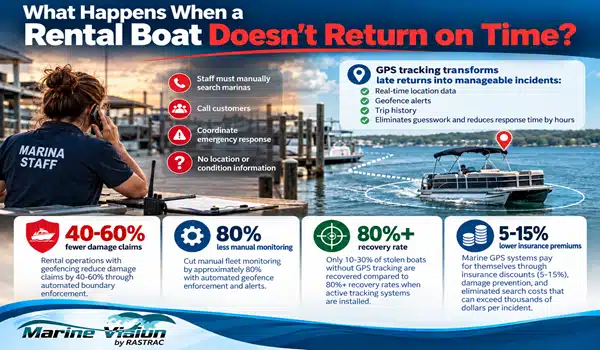
The Scenario: A 28-foot fishing boat assigned to slip C-14 begins moving at 2:17 a.m. Saturday morning. The watercraft exits the marina boundary within four minutes. Traditional security response: discovering an empty slip during the 6:00 a.m. round-nearly four hours after departure.
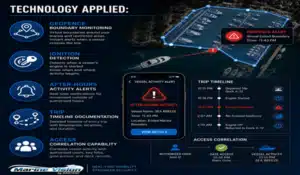
The Marine Vision Response: The ST4215 water-resistant GPS tracker installed on the fishing boat detects ignition activity and movement. The geofence system recognizes departure from the authorized marina zone. Security receives an immediate mobile alert containing the boat’s current location, direction, and speed.
Instead of learning about the incident at 6:00 a.m., the security chief has actionable intelligence at 2:21 a.m. – while the event is occurring. The four-hour discovery gap has been compressed to a four-minute notification window. Law enforcement receives not just a description of a missing fishing boat, but current coordinates, heading, and a documented movement timeline.
Key Security Shift: Response begins during the incident, not hours after. The ST4215’s water-resistant construction and marine-optimized installation ensure reliable tracking even in saltwater environments where standard trackers fail.
Technology Applied:
The Challenge: Sunday afternoon, a customer contacts marina security reporting their yacht is missing from slip B-7. The security chief must quickly determine whether the watercraft was stolen, relocated by marina staff for maintenance, taken by a family member with keys, or moved during the previous night’s storm.
Traditional Investigation Path: Review 48 hours of security footage across four cameras. Interview dock staff who worked Saturday and Sunday shifts. Check maintenance logs for authorized relocations. Contact the customer’s family members. Estimated timeline: 3-6 hours before establishing basic facts.
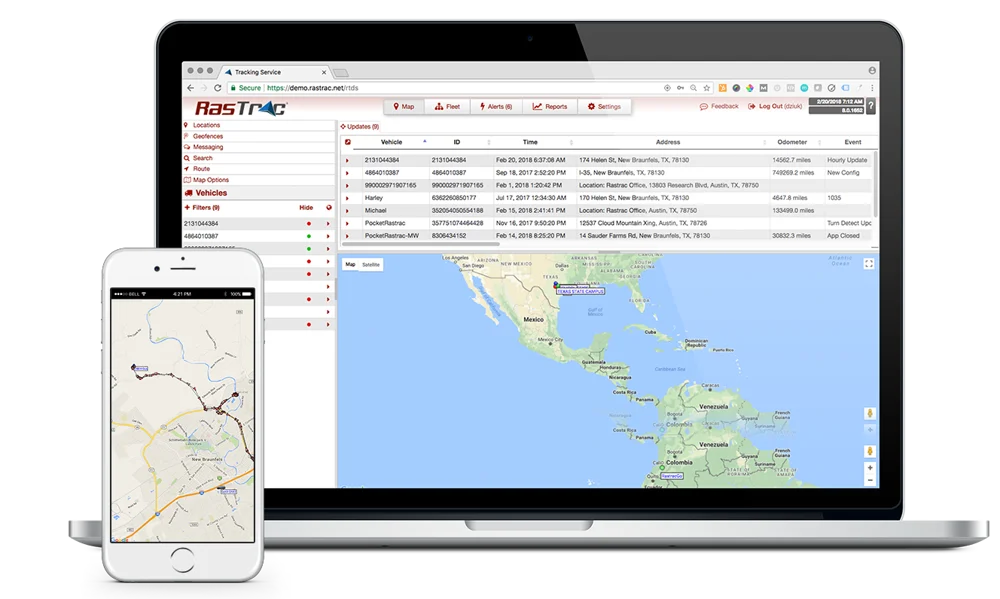
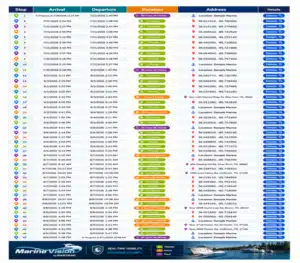
The Marine Vision Investigation: The security chief logs into the Rastrac platform and pulls the yacht’s movement history. The system provides:
The yacht wasn’t stolen. The customer’s adult son took the watercraft to a friend’s lakeside property and forgot to notify his father. Investigation time: 12 minutes instead of 3-6 hours.
The Broader Security Value: Marina personnel avoided filing a false theft report with law enforcement. The customer relationship was preserved with factual evidence rather than speculation. Staff time wasn’t consumed interviewing employees about a non-incident.
Documentation Advantage: The timestamped GPS record provided an objective account that eliminated conflicting narratives. When the customer initially insisted “nobody else has keys,” the movement data proved otherwise.
Technology Applied:
The Challenge: Marina employees, contractors, and slip-holders all have legitimate dock access via gate codes and keys. That access is necessary for operations. But dock access and boat authorization are separate permissions that traditional security systems can’t distinguish.
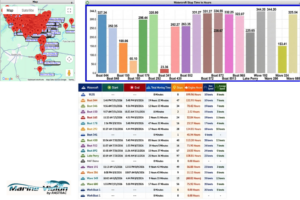
The Scenario: A marina establishes geofence monitoring on 15 high-value boats including a 32-foot center console owned by an absentee customer who visits monthly. Late Saturday evening, the center console’s engine starts. The watercraft exits the marina at 11:43 p.m. and travels 22 miles to a popular weekend anchorage.
Security receives the geofence departure alert. The trip history shows a six-hour stay at the anchorage followed by return to the marina at 5:18 a.m. Sunday – before the morning shift arrives.
The Investigation: The security chief reviews the gate access logs. A contracted maintenance worker used their code at 11:35 p.m. Saturday. The watercraft movement timeline aligns with that gate entry. Confronted with the GPS evidence, the contractor admits taking the center console for a “test run” after performing routine work.
The Deterrence Factor: Word spreads quickly in marina communities. Personnel with access now understand that boat movement creates documentation – even when nobody is standing on the dock watching. The security chief doesn’t need to increase patrols. The tracking system creates accountability automatically.
Prevention Through Visibility: Three months after implementing Marine Vision tracking, after-hours movement incidents at the marina dropped significantly. The technology didn’t catch more theft – it prevented unauthorized usage before it started.
Technology Applied:
The Challenge: A 200-slip marina has invested $180,000 in comprehensive security infrastructure: controlled access gates, 12 high-resolution cameras with 30-day storage, motion-activated lighting, and two full-time security officers. The system excels at protecting the marina property. But camera coverage ends at the property line.
The Scenario: Thursday at 4:22 a.m., security footage shows two individuals accessing slip F-12, boarding a speedboat, and departing. The camera captures clear images of the individuals and timestamps the departure. Within six minutes, the speedboat travels beyond camera range.
Traditional response: Provide law enforcement with camera footage, boat description, and last known direction. Hope the watercraft is recovered before it’s stripped, repainted, or moved out of state.
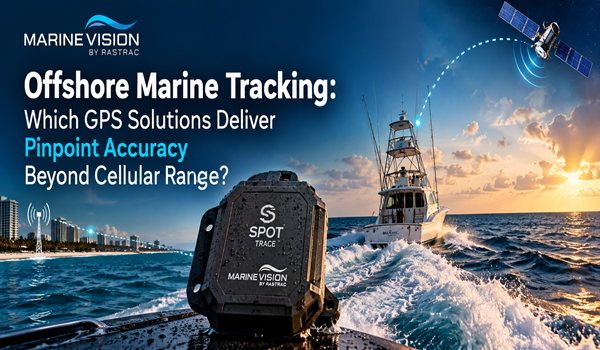
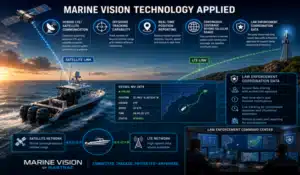
The Layered Security Response: The speedboat carries an ST9100 hybrid LTE/satellite tracker. When the watercraft leaves cellular coverage heading offshore, the device automatically switches to satellite communication. Security provides law enforcement with:
Law enforcement intercepts the speedboat 47 miles offshore at 9:15 a.m. – five hours after theft. Without GPS tracking, the watercraft would have disappeared beyond the horizon with only camera evidence of its departure.
The Security Layer Comparison:
Cameras provide: What happened, who was involved, when it occurred, initial direction
GPS tracking provides: Current location, complete route history, speed and heading, position beyond property lines
Combined system delivers: Complete incident documentation from access through recovery
The Investment Perspective: The marina had spent $180,000 on perimeter security infrastructure. Adding GPS tracking to 200 boats cost $62 per boat for hardware plus $24.95 monthly service. The total annual investment: approximately $72,300. The first recovered speedboat – valued at $84,000 – justified the entire year’s GPS tracking expense.
Technology Applied:
How quickly do marina security teams receive movement alerts after a boat starts moving?
Alert timing depends on your tracking device configuration, but typical marina security setups deliver notifications within 60-90 seconds of detected movement. The ST4215 water-resistant tracker can be programmed for high-frequency reporting when motion is detected, ensuring your security team knows about unauthorized departures while response is still possible. With Rastrac’s 99.99% uptime record across 30+ years of operations, you can rely on consistent alert delivery even during overnight and weekend shifts when marina staffing is minimal.
Can GPS tracking help with boats stored on trailers in marina parking areas?
Absolutely. The BeMini ultra-compact tracker works perfectly for trailered boats because it’s only one-quarter the size of standard GPS devices and includes a rechargeable battery that requires no hardwiring. You can track pontoon boats, jet skis, and other watercraft whether they’re in slips, on trailers, or in covered storage. The IP67 waterproof rating ensures reliable performance in marine environments, and the device can be discreetly mounted where thieves won’t find it during quick inspections.
What happens to GPS tracking when boats leave cellular coverage and head offshore?
The ST9100 hybrid device automatically switches between LTE cellular and satellite communication based on signal availability. When a sailboat or fishing boat travels beyond cellular range, the satellite system maintains position reporting, so your tracking capability doesn’t end at the coast. This is particularly valuable for marinas near open water where stolen boats can quickly move beyond cellular coverage. The device handles the network switching automatically – security personnel see continuous tracking without manual intervention.
How does GPS tracking integrate with our existing marina security camera system?
Marine Vision tracking operates through the Rastrac web platform and mobile apps, providing an independent layer that complements your camera system rather than replacing it. Cameras document what happened at the dock; GPS tracking shows where the watercraft went afterward. Many marina security chiefs use split-screen setups displaying both camera feeds and the Rastrac tracking map simultaneously. When an alert triggers, you can review camera footage to see who accessed the boat while simultaneously monitoring its real-time location. The two systems work together to provide complete incident documentation from access through recovery.
Can we set up different alert rules for boats with different risk levels or usage patterns?
Yes. The Rastrac platform allows you to configure unique geofences, alert schedules, and reporting frequencies for each individual watercraft. High-value yachts might have 24/7 movement monitoring, while regularly-used fishing boats might only trigger alerts during specific after-hours windows. You can also create multiple geofence zones – one alerting when boats leave their assigned slips, another when they exit the marina boundary, and a third when they travel beyond a certain distance offshore. This customization prevents alert fatigue while ensuring your security team receives notifications for genuinely unusual activity.
Detection beats discovery every time. Marina security chiefs who implement boat-level GPS tracking don’t just recover more stolen watercraft – they prevent unauthorized usage before it becomes a customer notification problem.
Rastrac Marine Vision has protected over $2.5 billion in assets across 30+ years, bringing industrial-strength tracking expertise to marine security applications. Whether you’re protecting 15 boats or 500, our water-resistant and hybrid satellite trackers extend your security visibility from the property line to open water.
Request a Demo | (877) 680-1188 | sales@rastracmarinevision.com