- 12741 Research Blvd. Suite 500 Austin, TX
- sales@rastracmarinevision.com
- (877) 680-1188
Marina operators excel at traditional security measures: locked gates, surveillance cameras, staff patrols, and proper lighting across dock facilities. But security threats evolve faster than conventional protection methods. Organized theft rings now use sophisticated tools to defeat standard security, target specific yacht and speedboat models for overseas markets, and move stolen watercraft across state lines within hours of theft occurrence. Simultaneously, connected marine systems create cybersecurity vulnerabilities that threat actors increasingly exploit. Insurance carriers respond by raising premiums and requiring enhanced security documentation. The operators who maintain asset protection and insurance affordability won’t just add more cameras and better locks – they’ll implement integrated GPS tracking that prevents theft through visible deterrence, enables rapid recovery when theft occurs, addresses emerging cyber risks, and qualifies operations for insurance premium reductions that compound annually.
Marine industry theft statistics reveal concerning trends: the sector loses $300M+ annually to theft, with only 10-30% of untracked watercraft recovered. But aggregate numbers mask the evolution happening within theft patterns. Opportunistic thieves targeting unlocked jet skis or unattended fishing boats represent decreasing percentages. Organized rings conducting targeted operations account for growing theft volumes.
Modern theft operations target specific boat models with strong overseas resale markets. Criminals research marina layouts, identify surveillance blind spots, use professional-grade tools to defeat conventional security, and coordinate transportation logistics for rapid asset movement. A stolen yacht or catamaran disappears across state lines within 24 hours, reaches overseas shipping containers within days, and arrives at foreign buyers before victims complete insurance claims.
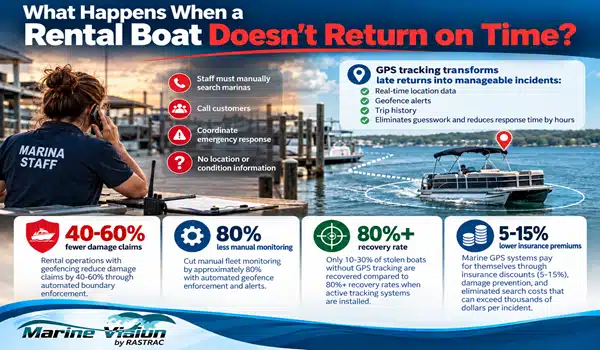
GPS-tracked boats reverse recovery statistics dramatically: 80%+ recovery rates because law enforcement locates stolen assets within hours instead of hoping someone recognizes a missing speedboat months later at a distant marina. But recovery capability represents only one GPS security benefit.
The most effective theft prevention happens before criminals attempt theft. Visible GPS tracking decals function as powerful deterrents – signaling that theft triggers immediate law enforcement notification with precise location data. Organized rings targeting high-value yachts or performance boats bypass GPS-monitored assets, moving to the next marina where boats lack tracking systems.
Deterrence effect compounds across entire fleets. A rental operation with 30 pontoon boats displays GPS monitoring decals on every unit. Potential thieves recognize that stealing any boat triggers immediate alerts, enabling rapid law enforcement response while the watercraft remains within recovery range. That visible deterrence protects the entire fleet without requiring expensive physical barriers or 24-hour security personnel.
Real-time alerts transform security response from reactive investigation to proactive intervention:
For yacht clubs managing member-owned boats worth $500K-$2M each, GPS tracking provides more than theft recovery, it delivers insurance qualification and premium reduction.
Insurance carriers increasingly require documented security measures including GPS tracking for boats above specific values or within theft-prone regions. Operations demonstrating comprehensive monitoring qualify for 5-15% premium reductions, savings that pay for tracking system costs within 18-36 months while providing actual security capability beyond premium reduction alone.
Consider a 50-boat rental fleet with $180,000 annual insurance premiums. A 10% premium reduction saves $18,000 annually. The premium reduction alone covers GPS system costs while theft deterrence prevents total loss claims that spike future premiums through loss ratio impacts.
Demonstrated security measures influence insurance carrier decisions about coverage continuation, premium adjustments, and claim approval. GPS tracking provides documentation proving boats remained within covered operating areas, followed established security protocols, and enabled rapid theft response. That documentation supports favorable insurance relationships while delivering actual security protection.
Cybersecurity rarely appears in marina operator conversations but connected boat systems create attack surfaces that sophisticated threat actors increasingly exploit. Modern GPS tracking systems integrate with marine electronics, engine management platforms, and shore-based operations software. Each integration point represents potential vulnerability requiring security measures.
Rastrac’s platform architecture addresses emerging cyber threats through multiple protection layers:
Insurance carriers already mandate cybersecurity measures for commercial operations in other industries handling customer data or controlling facility access systems. Marine insurance requirements will follow – particularly for charter operations processing customer payments or marina management platforms controlling dock utilities and gate access. GPS tracking platforms meeting current cybersecurity standards position operators ahead of coming insurance requirements rather than scrambling to retrofit security measures after carriers mandate coverage or deny claims due to inadequate protection.
Autonomous and semi-autonomous boat technology remains 5-10 years from widespread recreational and rental adoption. But early deployments in commercial fishing, cargo transport, and survey operations demonstrate that autonomous systems require even more sophisticated GPS tracking than human-operated boats. Autonomous navigation depends on precise real-time location data, continuous shore-based communication, and comprehensive operational status monitoring.
The GPS infrastructure implemented for theft prevention and operational efficiency today becomes foundational technology for autonomous operations tomorrow. Early adopters position themselves with integrated systems ready for autonomous technology rather than facing expensive retrofits when autonomous boats become market standard.
Current GPS tracking deployment prepares operations for autonomous integration through several mechanisms:
Autonomous technology adoption will accelerate rapidly once regulatory frameworks clarify and early implementations prove reliability. Operations with GPS tracking infrastructure already deployed adapt seamlessly. Operations without tracking face implementation delays, learning curves, and integration challenges that create competitive disadvantages during autonomous technology transitions.
GPS tracking converts security investment into operational intelligence that drives fleet optimization decisions. Theft prevention and recovery represent immediate value, but operational insights compound returns over time.
Utilization tracking reveals which boats generate revenue, and which consume resources through maintenance and insurance without proportional return. Security features document operating area compliance for insurance, while that same location data identifies popular routes for marketing optimization and underutilized inventory for fleet composition adjustment.
A bass boat generating $40,000 annual revenue appears successful until GPS data reveals it sits unused 180 days yearly while comparable boats maintain 80% utilization. Armed with utilization metrics, operators make evidence-based decisions about fleet composition, retirement timing, and capital allocation – optimizing return on investment across all assets.
Technology evolution accelerates continuously. The GPS tracking infrastructure implemented today addresses immediate security and insurance needs while positioning operations for coming technological transitions. As autonomous systems, enhanced connectivity, and AI-driven optimization become standard, operators with existing GPS infrastructure adapt immediately rather than scrambling to retrofit basic capability.
Insurance requirements will expand. Cybersecurity mandates will follow patterns established in other industries. Autonomous technology will shift from experimental to standard. GPS tracking implemented now provides the foundational platform supporting all three transitions – protecting current operations while enabling future capabilities.
How does GPS tracking actually prevent boat theft versus just helping recovery?
Visible GPS tracking decals function as powerful deterrents before theft attempts occur. Organized theft rings targeting high-value boats bypass GPS-monitored assets because theft triggers immediate law enforcement notification with precise location data. Deterrence protects entire fleets – a rental operation displaying GPS monitoring on 30 pontoon boats signals that stealing any unit enables rapid response while the boat remains within recovery range. Real-time alerts compound prevention: geofence breach notifications, movement detection on trailered boats, and battery disconnect warnings identify theft attempts during critical windows when security response prevents completion. Recovery capability remains important – GPS-tracked boats achieve 80%+ recovery rates versus 10-30% for untracked watercraft, but prevention through visible deterrence provides even greater value by avoiding theft incidents entirely.
What cybersecurity risks does GPS tracking address for marina operations?
Connected boat systems create attack surfaces that sophisticated threat actors increasingly exploit. Modern GPS tracking integrates with marine electronics, engine management platforms, and shore-based operations software – each connection point represents potential vulnerability. Rastrac’s platform implements encrypted data transmission preventing interception of location and operational information, secure authentication limiting access to authorized users only, regular security updates addressing newly discovered vulnerabilities, and audit trail logging tracking system access for forensic investigation. Insurance carriers already mandate cybersecurity measures for commercial operations in other industries. Marine insurance requirements will follow, particularly for charter operations processing payments or marina management platforms controlling facility access. GPS tracking platforms meeting current cybersecurity standards position operators ahead of coming insurance mandates rather than retrofitting security after carriers require coverage.
How do insurance premium reductions justify GPS tracking costs?
Insurance carriers offer 5-15% premium reductions for fleets with active GPS tracking – savings that typically pay for system costs within 18-36 months while providing actual security protection. A 50-boat rental fleet with $180,000 annual premiums saves $18,000 annually through 10% reduction. The premium reduction alone covers tracking costs while theft deterrence prevents total loss claims that spike future premiums. Demonstrated security measures also influence insurance carrier decisions about coverage continuation, premium adjustments, and claim approval. GPS tracking provides documentation proving boats operated within covered areas, followed security protocols, and enabled rapid theft response, supporting favorable insurance relationships beyond direct premium reduction.
Will GPS tracking integrate with autonomous boat technology when it arrives?
Autonomous systems require even more sophisticated GPS tracking than human-operated boats – precise real-time location data, continuous shore-based communication, and comprehensive operational status monitoring. GPS infrastructure implemented today for theft prevention and efficiency becomes foundational technology for autonomous operations arriving in 5-10 years. Current tracking deployment prepares operations through precise location data collection, real-time communication systems, operational status monitoring, and geofencing capabilities that translate directly to autonomous navigation requirements. Early autonomous deployments in commercial fishing, cargo transport, and survey operations already integrate advanced GPS tracking as essential infrastructure. Operations with GPS tracking deployed now adapt seamlessly to autonomous technology. Operations without tracking face implementation delays and integration challenges creating competitive disadvantages during autonomous transitions.
How quickly can GPS tracking be installed across an existing marina fleet?
Installation requires minimal time for most marine applications. Battery-powered trackers mount in minutes – secure the device in a protected location, activate through the online platform, and begin tracking immediately. For boats with accessible power systems, straightforward hardwired installation takes 30-60 minutes per watercraft. Solar-powered options eliminate battery replacement for boats stored outdoors. Implementation work focuses on operational integration: configuring geofences around marina boundaries, establishing alert recipients for security notifications, training staff on platform access, and documenting security protocols. Rastrac provides comprehensive onboarding support for fleet-wide deployment. Most operators achieve complete tracking functionality within one week from device delivery, with theft deterrence and insurance documentation capability operational immediately upon activation.
Security threats, insurance requirements, and technology evolution converge simultaneously while marina operators manage daily dock operations, customer service, and maintenance schedules. GPS tracking designed specifically for marine applications addresses all three challenges through single-platform investment – delivering immediate security protection and insurance premium reduction while building infrastructure for tomorrow’s autonomous technology integration and cybersecurity compliance.
Rastrac Marine Vision brings 32 years of marine industry experience and specialized features that position rental fleets and charter operations ahead of security threats and insurance requirements. The question isn’t whether marina operators need comprehensive tracking and security capability – it’s whether you implement proactive protection now or respond urgently to theft incidents, insurance mandates, or technology transitions when competitors already have infrastructure advantage.
Request a Demo | (877) 680-1188 | sales@rastracmarinevision.com

Rastrac complements any organization-wide quality assurance program and can help their fleet become the model for operational superiority.
Rastrac helps clients make improvements in processes, organization, financials, communications, and technology. Clients that have taken advantage of Rastrac’s ability to provide solutions tailored to their business are in a wide variety of industries. Rastrac can help you find a solution, too.
We’d love to discuss how we can help you.
Basic service for your OEM-connected vehicles. No hardware. No installation.
Offer ends November 30, 2026
