- 12741 Research Blvd. Suite 500 Austin, TX
- sales@rastracmarinevision.com
- (877) 680-1188
Unexpected downtime on rental boats, pontoon fleets, and commercial fishing operations translates directly to lost revenue. A single day without a center console in the water during peak season can mean a five-figure revenue loss – and that’s before accounting for emergency service calls, parts expediting, and frustrated customers. Yet many fleet operators rely on reactive maintenance: they wait for a breakdown, call a mobile service tech, and hope the repair happens fast enough to get the watercraft back in rotation.
Predictive marine monitoring systems change that equation. By tracking engine hours, battery voltage trends, and operational stress in real-time, modern telematics platforms can alert you to maintenance needs before they become emergencies. This post walks you through how marine monitoring with predictive maintenance alerts works, what the leading platforms deliver, and how Rastrac Marine Vision helps boat rental companies, charter fleets, and commercial operators protect their assets and keep revenue flowing.
Traditional maintenance schedules (service every 100 hours or 12 months) treat all engines the same, ignoring actual wear and usage stress.
Modern marine telematics platforms collect:
Rastrac Marine Vision collects this data from onboard sensors via ST4215 (water-resistant) and ST9100 (hybrid LTE/satellite for offshore boats) devices.
Predictive maintenance reduces downtime by focusing service on actual need, not calendar assumptions.
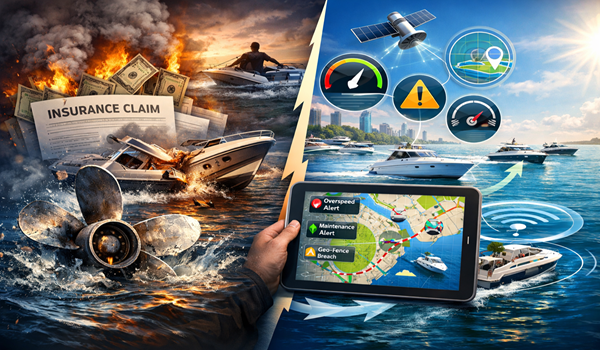
Propeller damage is the number-one unexpected expense in rental fleets. Inexperienced operators hit rocks, shallow reefs, or submerged obstacles – often in designated no-go zones you’ve marked on the rental agreement. Once the prop is bent or the drive is damaged, you’re looking at $3,000 to $15,000 in repairs and a week of lost rental income.
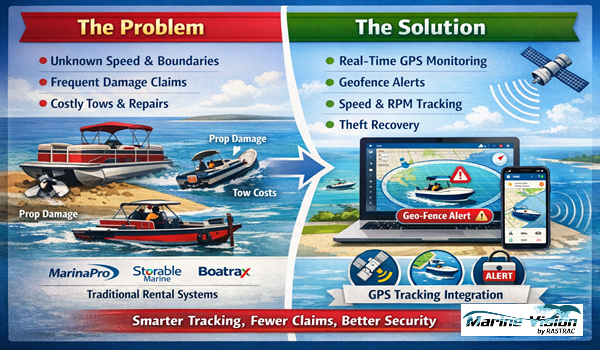
Marine GPS tracking with speed monitoring and geofencing prevents this:
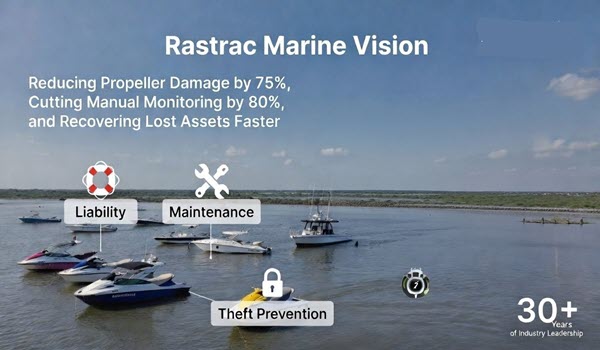
One boat rental operation reduced propeller damage by 75% in the first season after installing Rastrac Marine Vision tracking on their fleet. Renters knew they were monitored, operators were trained on safe zones, and maintenance staff could detect damage earlier when repairs are cheaper.
Rastrac Marine Vision combines GPS location tracking, engine health monitoring, and intelligent alerting into a single platform. Key capabilities:
Two primary devices serve marine fleets:
ST4215 – Water-Resistant Tracker
ST9100– Hybrid LTE/Satellite
Both devices integrate with the Rastrac Marine Vision platform and sync engine hours, battery voltage automatically. No manual data entry, no guesswork.
Challenge: One boat rental company suffered 2-4 propeller damage incidents per month during peak season, each costing $4,500 in parts/labor and 5-7 days of downtime.
Solution: Deployed Rastrac Marine Vision on 35 rental pontoons and center consoles; set speed alerts for shallow bays and created geofences around known hazard zones.
Results:
“The first boating season after installing Rastrac devices on our watercraft fleet, we reduced our propeller damage by 75%. As a result of the reduced propeller damage, we realized a substantially reduced amount of downtime within our fleet, increasing our overall revenue.”
Manual oversight is expensive. A rental manager or supervisor checking in on 20 boats, verifying engine hours, cross-referencing maintenance logs, and calling around about fuel levels consumes hours per week. Rastrac Marine Vision automates that work:
| Capability | Why It Matters | Rastrac Marine Vision |
| Engine hour tracking | Accurate maintenance triggers; prevents premature/overdue service | ✓ Real-time sync |
| Battery monitoring | Avoid dead battery surprises | ✓ Continuous tracking |
| Speed + geofence alerts | Prevent unauthorized zones; catch damage-causing behavior early | ✓ Integrated, configurable |
| Maintenance due notifications | Proactive alerts before intervals are missed | ✓ Email & SMS |
| Offline/satellite fallback | Coverage in remote waterways; reliability in dead zones | ✓ ST9100 hybrid LTE/satellite |
| Analysis | Predict failure (battery decline) before emergency | ✓ 90-day cloud history + archive on request |
| API for rental system integration | Sync reservations, fuel fills, maintenance history with booking software | ✓ RESTful Web API |
| Mobile app for field staff | Technicians check maintenance history and work orders from the dock | ✓ iOS & Android PocketRastrac |
Not every GPS device is built for marine environments. Salt spray, humidity, and constant exposure to water corrode standard electronics. Rastrac Marine Vision hardware is purpose-built:
Q: How far in advance can a marine monitoring system predict engine failure?
A: Depends on the failure type. Battery voltage decline, for example, is often predictable 2–4 weeks in advance (voltage drops consistently day by day). The key is continuous monitoring systems like Rastrac Marine Vision track trends, not just snapshots.
Q: Will geofencing and speed monitoring make renters feel surveilled?
A: Disclosure is key. Rental agreements should clearly state that watercraft are GPS-equipped and monitored for safety and asset protection. Most renters accept this as standard practice – similar to how car rentals track vehicles. In fact, many renters feel safer knowing the boat is monitored; if something goes wrong, help can reach them faster. Rastrac Marine Vision documentation supports this communication.
Q: What if a boat operates in areas with poor cellular coverage?
A: Rastrac’s ST9100 hybrid device switches automatically from cellular (LTE Cat-M1) to satellite when cell signal drops. This ensures continuous tracking and alerts even 100+ miles offshore or in remote inland waterways. Satellite fallback costs more per month but is essential for charter fleets and commercial fishing operations.
Q: Can I integrate Rastrac Marine Vision with my existing boat rental booking system?
A: Yes. Rastrac offers a RESTful Web API that allows custom integration with most booking platforms. You can automate fuel and maintenance data sync, pre-populate inspection reports, and link GPS history to reservations. Custom development is available through Rastrac’s in-house team.
Q: How much does marine monitoring typically cost?
A: Pricing varies by hardware (ST4215 is lower cost; ST9100 satellite is higher), reporting frequency, and contract term. Most rental fleets see payback within 2–3 months through reduced damage claims, fewer emergency repairs, and increased uptime revenue. Request a demo to get a custom quote for your fleet size.
Q: What happens if a device loses power or gets damaged?
A: Rastrac devices include battery backup and are designed to survive accidental impacts. If a device is damaged, you swap in a replacement; the platform continues tracking other watercraft uninterrupted. Rastrac’s hardware-agnostic philosophy also means you’re not locked into proprietary devices – you own the hardware after purchase.
Protect Your Watercraft Fleet Today
Unexpected downtime costs more than you think – lost rental revenue, emergency service calls, customer refunds, and liability exposure all add up fast. Predictive marine monitoring systems like Rastrac Marine Vision eliminate the guesswork, alert you to problems before they become emergencies, and reduce downtime by up to 75%.
Start with a free trial. See how real-time engine monitoring, geofencing, and speed alerts work on your fleet. Discover how to turn reactive maintenance into proactive protection – and keep your boats earning revenue.
Request a Demo | Purchase Devices | (877) 680-1188 | sales@rastrac.com

Rastrac complements any organization-wide quality assurance program and can help their fleet become the model for operational superiority.
Rastrac helps clients make improvements in processes, organization, financials, communications, and technology. Clients that have taken advantage of Rastrac’s ability to provide solutions tailored to their business are in a wide variety of industries. Rastrac can help you find a solution, too.
We’d love to discuss how we can help you.