- 12741 Research Blvd. Suite 500 Austin, TX
- sales@rastracmarinevision.com
- (877) 680-1188
A Florida yacht charter company discovered $47,000 in unauthorized fuel charges over eight months. The culprit? Three employees were taking luxury cruisers out after hours, sometimes with their families, racking up hundreds of engine hours that weren’t tied to any customer bookings. The owner had no idea until a routine insurance audit flagged the discrepancy between reported usage and actual engine wear.
This scenario plays out more often than marine operators realize. Whether it’s employees taking pontoon boats for weekend fishing trips, rental customers extending their time without paying, or family members “borrowing” commercial watercraft, unauthorized use represents one of the most significant hidden costs in marine operations. Without GPS tracking systems that capture every movement, ignition event, and location change, these losses remain invisible until they become catastrophic. The solution isn’t just monitoring; it’s creating an audit trail that makes unauthorized use impossible to hide and unprofitable to attempt.
Employee-related unauthorized use falls into three categories: after-hours joyriding, undocumented personal errands during work hours, and lending boats to friends or family. A fishing charter operator in Louisiana learned this the hard way when his $85,000 center console developed engine problems at just 400 hours – half the expected lifespan. GPS tracking revealed that two captains were regularly taking the boat out on non-charter days, pushing the twin outboards to maximum RPM in patterns inconsistent with customer trips.
The financial impact extends beyond fuel and maintenance. Unauthorized use accelerates depreciation, voids manufacturer warranties when service intervals are missed, and creates liability exposure if accidents occur during non-business activities. Insurance companies increasingly require proof that watercraft were being used for approved purposes at the time of any incident.
GPS tracking eliminates the opportunity by creating transparency. When employees know that every ignition event, location, and runtime is captured with timestamps, the temptation to misuse company equipment drops dramatically. One marina operator reported a 73% reduction in unauthorized engine hours within 60 days of installing Rastrac tracking devices on his 22-boat rental fleet.
Rental operations face a unique challenge: customers who extend their time without permission or return late, claiming they “didn’t realize” how long they’d been out. A Lake Tahoe ski boat rental company was losing an average of 4.2 hours per week in unreported usage until GPS tracking revealed the pattern. Customers were routinely keeping wakeboard boats for 6-7 hours while only paying for 4-hour reservations.
The math adds up quickly. At $150/hour for a premium ski boat, unreported usage of just 4 hours weekly equals $31,200 in lost annual revenue per watercraft. Multiply that across a 15-boat fleet, and you’re looking at nearly half a million dollars in undetected losses.
GPS tracking solves this problem by:
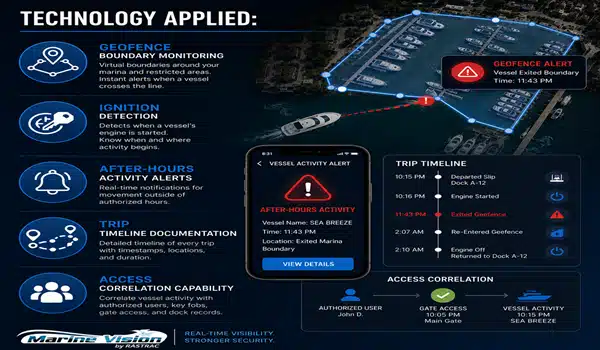
Geofence technology takes this further by establishing virtual boundaries. When a pontoon boat crosses outside the approved rental area, managers receive instant alerts. This prevents customers from taking coastal rentals into rough offshore waters, violating insurance restrictions, or entering prohibited zones where they could face Coast Guard citations.
Unauthorized family use often overlaps with after-hours scenarios. The dock manager’s teenage son taking a bowrider out at midnight. The maintenance supervisor’s brother-in-law using a bass boat every Saturday. The office manager’s family treating company sailboats like their personal fleet. Without timestamped GPS data, these incidents remain undetected until an accident forces them into the light, usually accompanied by an insurance claim denial.
Marine insurance policies contain strict use clauses. Coverage typically applies only when watercraft are operated by authorized personnel for approved purposes during specified hours. Unauthorized use doesn’t just void coverage for that specific incident – it can trigger retroactive policy cancellation and leave operators personally liable for damages, injuries, or environmental cleanup costs.
A Mississippi charter operation learned this when an employee crashed a $120,000 catamaran into a dock at 2 AM on a Sunday. The insurance company denied the $68,000 claim because the operator couldn’t prove the employee was authorized to use the boat at that time. Without GPS tracking showing a pattern of after-hours management approval, the insurer successfully argued that employee theft had occurred, placing the loss entirely on the owner.
GPS audit trails provide the documentation insurers require. Timestamped location data, speed patterns, and ignition records create a defensible narrative. When you can show exactly where a speedboat was, who had access based on timecard data, and whether the operation aligned with business hours and approved routes, you transform a subjective dispute into an objective fact pattern.
The insurance benefits of GPS tracking include:
Rastrac customers report that GPS documentation has saved them an average of $23,000 per incident when disputing questionable insurance claims. The technology pays for itself the first time it prevents a coverage denial on a major loss.
Modern GPS tracking captures more than just location. Rastrac systems record ignition on/off events, idle time, maximum speeds, rapid acceleration patterns, and geofence violations. This comprehensive data creates a timeline that’s admissible in legal proceedings, insurance disputes, and employee disciplinary actions.
Consider the power of showing an employee GPS data that proves they took a jet ski 47 miles from the marina during their lunch break, reached speeds of 62 mph, and returned with 3.2 additional engine hours all while clocked in for regular work. There’s no room for “I don’t remember” or “That wasn’t me.” The audit trail eliminates plausible deniability.
Location history extends beyond single trips. Patterns emerge over weeks and months. You can identify if certain watercraft are consistently operated in unauthorized areas, if specific employees generate more high-speed events than others, or if after-hours usage correlates with particular maintenance issues.
The deterrent effect is significant. When you announce that all company boats now have GPS tracking with complete audit trails, unauthorized use typically drops 60-80% immediately. The remaining incidents tend to be genuine emergencies or misunderstandings rather than intentional misuse.
Geofencing creates virtual boundaries around marinas, approved waterways, or rental zones. The moment a fishing boat crosses that boundary, designated managers receive SMS or email alerts. This real-time notification system transforms GPS tracking from passive documentation to active prevention.
A North Carolina yacht management company uses geofences to monitor 14 vessels worth a combined $8.3 million. When a 52-foot yacht left its designated mooring area at 11 PM on a Tuesday, the owner received an immediate alert. He contacted the harbor master, who discovered a dock hand attempting to steal the yacht. Police arrived within minutes. Without the geofence alert, the theft would have succeeded, potentially resulting in hundreds of thousands in loss or damage.
Geofences also protect against well-meaning but unauthorized use. An employee might genuinely believe they have permission to take a pontoon boat for a quick personal errand. The geofence alert gives managers the opportunity to intervene immediately, turn a potential disciplinary issue into a teaching moment, and prevent the situation from escalating.
Practical geofence applications include:
Rastrac’s geofencing includes customizable alert levels. You can set one threshold for informational alerts (the sailboat left the harbor) and another for urgent notifications (the speedboat is traveling at excessive speed outside approved hours). This tiered approach prevents alert fatigue while ensuring critical events get immediate attention.
How does GPS tracking prove who was operating the boat during unauthorized use?
GPS tracking provides timestamped location and ignition data that, when cross-referenced with employee schedules, access logs, and key management records, creates a clear picture of who had access to each watercraft. Rastrac systems capture every ignition event with precise timing, allowing you to match boat movement with employee clock-in/clock-out records, security camera footage, or marina access logs. While GPS doesn’t identify the operator by name, the circumstantial evidence it provides combined with your operational records typically makes unauthorized users identifiable and leaves little room for false denials.
Can customers disable GPS tracking devices to avoid detection during after-hours rental use?
Professional marine GPS tracking devices like those from Rastrac are designed to be tamper-resistant and nearly impossible for customers to locate or disable without tools and technical knowledge. The units are typically hardwired into the electrical system in concealed locations, and any attempt to disconnect power triggers an immediate alert to managers. Additionally, sophisticated tracking systems include backup batteries that continue reporting location even if primary power is cut. Some operators inform renters that GPS tracking is active, which alone deters most unauthorized use attempts.
Does GPS tracking lower my marine insurance premiums, and how much documentation do I need to provide?
Many marine insurers offer 5-15% premium reductions for operators who install GPS tracking systems, as the technology demonstrably reduces theft, improves recovery rates, and prevents unauthorized use. You’ll typically need to provide proof of installation, documentation showing the tracking system is monitored regularly, and evidence that you have protocols for responding to alerts. Rastrac customers report that GPS audit trails have been instrumental in defending against fraudulent claims and proving authorized use during coverage disputes, often saving far more than the annual premium reduction.
What happens if an employee claims they had verbal permission to use the boat after hours?
GPS audit trails don’t resolve verbal permission disputes on their own, but they shift the burden of proof significantly. When tracking data shows a pontoon boat left the marina at 8 PM on a Saturday, traveled 23 miles to a recreational area, and returned at 11 PM, management can review communication records, check if that trip aligned with any business purpose, and verify if proper approval protocols were followed. Most companies implement written authorization requirements specifically because GPS makes unauthorized use visible. The combination of tracking data and clear policies eliminates the “I thought it was okay” defense.
How quickly do geofence alerts notify me when a boat leaves an authorized area?
Rastrac’s geofence alerts typically notify designated recipients within 30-90 seconds of a watercraft crossing a virtual boundary, depending on cellular coverage in the area and the tracking device’s reporting interval. You can configure alerts to send via SMS, email, or both simultaneously to multiple managers. The real-time nature of these notifications gives you the opportunity to contact the operator, verify authorization, or dispatch security before a situation escalates. For critical geofences like marina perimeters during closed hours, many operators set alerts to sound on multiple phones simultaneously to ensure someone responds immediately.
Unauthorized boat usage isn’t just a management annoyance; it’s a measurable drain on profitability that compounds with every undetected incident. GPS tracking transforms your watercraft from unmonitored assets into comprehensively documented business tools where every movement, every ignition event, and every hour of operation creates an irrefutable record.
Rastrac has protected marine operators for 32 years with GPS technology designed specifically for the challenges you face: after-hours employee use, rental customers who exceed their time, unauthorized family members treating your fleet like personal toys, and insurance disputes that hinge on proving exactly what happened and when. The cost of tracking is a fraction of what you’re already losing to undetected unauthorized use.
Request a Demo | (877) 680-1188 |sales@rastracmarinevision.com

Rastrac complements any organization-wide quality assurance program and can help their fleet become the model for operational superiority.
Rastrac helps clients make improvements in processes, organization, financials, communications, and technology. Clients that have taken advantage of Rastrac’s ability to provide solutions tailored to their business are in a wide variety of industries. Rastrac can help you find a solution, too.
We’d love to discuss how we can help you.

No hardware, no installation.
Activation fee waived for every device.
Save 20% on service for six months.
